
Pocahontas Gameplay
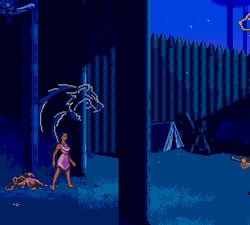
Playing Pocahontas on the Sega Genesis/Mega Drive feels like stepping from a sunny clearing into the cool hush of the forest. The pace doesn’t shove; it whispers: ease up, watch your footing, listen to the wind. This isn’t about fists or chasing score ticks — it’s a path where every leap and every breath is tied to the wild. Disney’s Pocahontas on a 16-bit cartridge doesn’t hurry you, but it honestly teaches the trail’s rhythm: when to still, when to jump, and when to trust the river’s pull.
Two heroes — one beat
The heart of the game is the duo. At first, swapping between Pocahontas and Meeko feels like a cute gimmick, but it quickly clicks: without trading roles, you won’t get far. Meeko is a nimble raccoon — squeezes through gaps, nudges levers, distracts when it matters. Pocahontas moves smoother and surer; she reads the ground, gauges safe distance, lands like a feather. It’s not “the fast one” and “the strong one,” it’s two halves of one route. One moment you guide Meeko across dangling platforms to drop a rope; the next, Pocahontas clears rain-sculpted ledges using what Meeko unlocked earlier. You swap without fuss — and the puzzle unspools into a flowing dance. Not a textbook puzzle-platformer, but a well-directed woodland ramble where every meter is a small test of wit and timing.
Gifts of the spirits
Power-ups here aren’t swords or armor — they’re abilities gifted by the forest. Free a creature, and you earn its strength. The deer spirit adds a gentle shove to your jump — suddenly that “impossible” gap is within reach. The eagle’s gaze sketches the right route in your head, marking safe ground and empty air. The otter teaches you to dive and ride currents, while the wolf’s nose reveals hidden paths and tracks you’d never spot by eye. These spirit gifts set off a real cascade of feel: you loop back to earlier ledges, re-approach familiar scenes in new ways, and bask in a world that opens not with a switch, but with new facets of your movement.
Crucially, none of it sits on top — it’s woven into the route. Picture a long rock shelf that’s just out of reach. At first it taunts you. After meeting the deer, you get it: build momentum, hit the apex — fingertips hook the edge. Below, that scary whirlpool that once warned you off now invites an otter-style entry: slip in at the right angle and the current slingshots you into a pocket grotto where another animal waits for freedom. In Disney’s Pocahontas, moments like this make the adventure warm: not a checkbox in a menu, but a genuine “I couldn’t do that before.”
A path that breathes
Levels live and breathe, not just as layouts. Leaves whisper, rock is cool to the touch, water snaps like it’s alive. There’s a timer of sorts — not digits, a metronome inside you. Charging ahead backfires: the ground has spring, the vine has swing, and your second attempt often lands cleaner than the first. The rhythm in Pocahontas on Mega Drive is gentle but exacting: haste drops a jump, patience opens a shortcut. When hazards show — rockfalls, sharp roots, wobbly logs — the game doesn’t scold; it nudges: listen closer, try another angle.
The river and the rapids
The whitewater stage is the calling card. You’re on a log, but really you’re in the flow: the current bumps, spins, and shouldered you toward rocks. You breathe with the river, time your entry, hug the calm edges — and the jitters melt away. Pocahontas on Sega serves up that rare sensation where you don’t conquer nature — you learn to move with it. Hops across jutting snags, rolls from riffles into pools, a short tuck beneath a ledge — here, it’s not about speed but clean motion. Miss a beat? Not a disaster; you won’t get hurled back to square one, but your hands remember the lesson. Next run you slip into the stream a hair earlier and lace through a whirlpool like you always could.
The settlers’ camp
When the trail leads to the English encampment, the volume drops. A different tension blooms — not from heights and water, but from eyes. It’s stealth without the gloom: you’re not hiding in crates or throwing smoke, you thread between pickets, read lantern cones, hear muffled boots. Meeko’s fidgety nature shines: he ducks under decking, nudges hooks, flicks latches. Meanwhile, Pocahontas measures her steps: sometimes you wait it out, sometimes you slip by in the tent’s shadow. No muskets raised, no brawl — and that restraint makes it ten times tighter than a chase. In this Disney Pocahontas, conflict resolves not with a blow, but a route choice.
Tactile puzzles
Challenges are solved with your hands. Sync to a swinging platform, catch the vine on the backswing; shepherd Meeko so he lands across the break in tandem with you. Swapping characters is like changing the song’s tempo: one quick click and the scene plays different. Now and then, the game tosses “knots” — spiral paths where only the wolf’s sense spots the right lip, or water pockets that unfold with the otter’s knack. But the puzzle never hard-walls you: the difficulty is tuned, letting you feel clever, not crammed for a makeup test.
No assault timer here, but there is an inner beat. The softer you load a jump, the farther it carries; the calmer you let go at the lip, the cleaner you stick the landing. That pulse clicks instinctively — and once you find it, you see why Disney’s Pocahontas exists. It’s a rare side-scroller where the prize isn’t just the next scene, but the sense that you learned to listen to the trail.
What sticks are the little things: spirit emblems glinting at the screen’s edges, a shortcut unfurling after you free a creature, the warm, measured way this Disney game “talks” without words. Some call it Pocahontas on Mega Drive, others “Pocahontas 16-bit” — either way, it’s the same tale about attention. In the wilds and in the settlers’ camp, it isn’t might that wins, but sensitivity. That’s the real joy: you don’t just clear a level — you live it, step by step learning to be part of the world, not the center of the stage.